
Conduit rarely follows a straight line through a plant. It turns around equipment, branches towards different loads and passes through spaces that can be awkward to reach.
Where hazardous-area installations use metal conduit, conduit outlet boxes provide access for pulling, routing and inspecting the conductors. They are used in applications ranging from chemical processing and paint shops to pharmaceutical production and grain handling, provided the selected model is suitable for the area’s gas or dust hazards.
Getting the right box starts with understanding its job—and the limits of what it is designed to do.
How the Protection Works
Key point: Conventional explosion-proof conduit outlet boxes use increased-safety protection (Ex e). They have no flameproof chamber, cannot contain an internal explosion and must not be used for making electrical connections.
1. An explosion-proof conduit outlet box has an empty interior and is used only to allow cables to pass through. It contains no terminals, electrical contacts or electrical components. Since it does not generate sparks itself, it does not require a flameproof structure.
2. Its protection principle is increased safety: precision threads, a sealed enclosure and complete sealing prevent hazardous conditions from developing.
Its sole purpose is to keep the entire explosion-protected conduit system sealed and block the path of explosion propagation.
Explosion-protected steel conduit wiring forms a completely enclosed system. If ordinary fittings with large gaps at the joints are used, flammable gases and combustible dust from the surrounding area can enter and accumulate inside the conduit. If a short circuit produces sparks inside a light fitting, distribution panel or junction box, the resulting explosion will propagate along the entire conduit run, triggering a chain of explosions.
Through high-precision threaded connections, explosion-proof conduit outlet boxes keep the entire conduit run fully sealed, preventing flammable and explosive substances from entering. This eliminates the risk of explosion propagation at its source. They also keep the enclosure surface temperature within strict limits, preventing hot surfaces from igniting flammable substances in the surrounding area.
Conduit Outlet Boxes and Junction Boxes
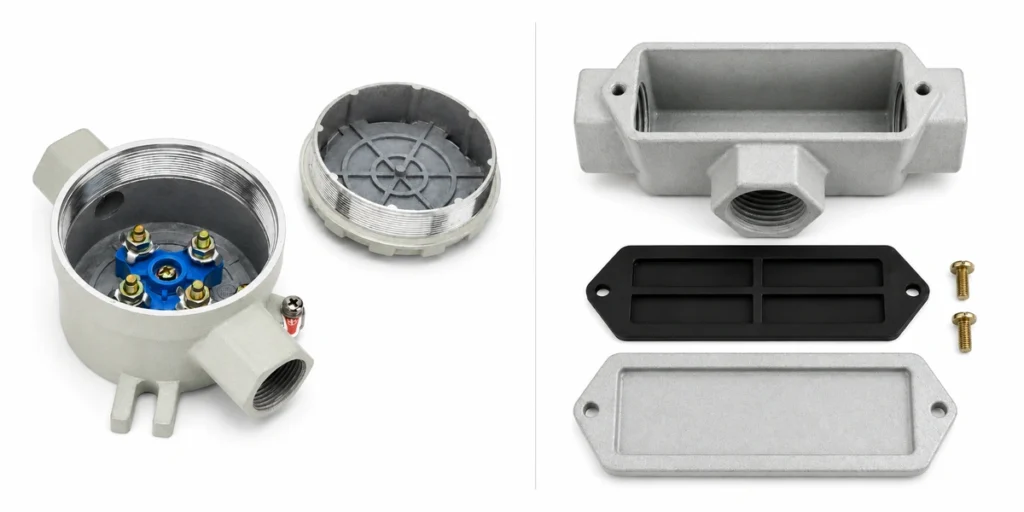
- Explosion-Proof Conduit Outlet Boxes (Ex e, Increased Safety)
An empty enclosure for cables to pass through, with no terminals installed. Electrical connections and conductor branching are not permitted inside. Its role is to connect conduit sections, accommodate changes of direction and protect cables. It has no flameproof joints.
- Explosion-Proof Junction Boxes (Ex d, Flameproof)
It has flameproof joints, a removable cover and internal terminal blocks. It is used for branching and joining cables. It can withstand an internal explosion and is a true flameproof device.
Installation rule: Use conduit outlet boxes for cable routing and junction boxes for electrical branching and connections. The two must not be used interchangeably.
Common Types of Conduit Outlet Boxes
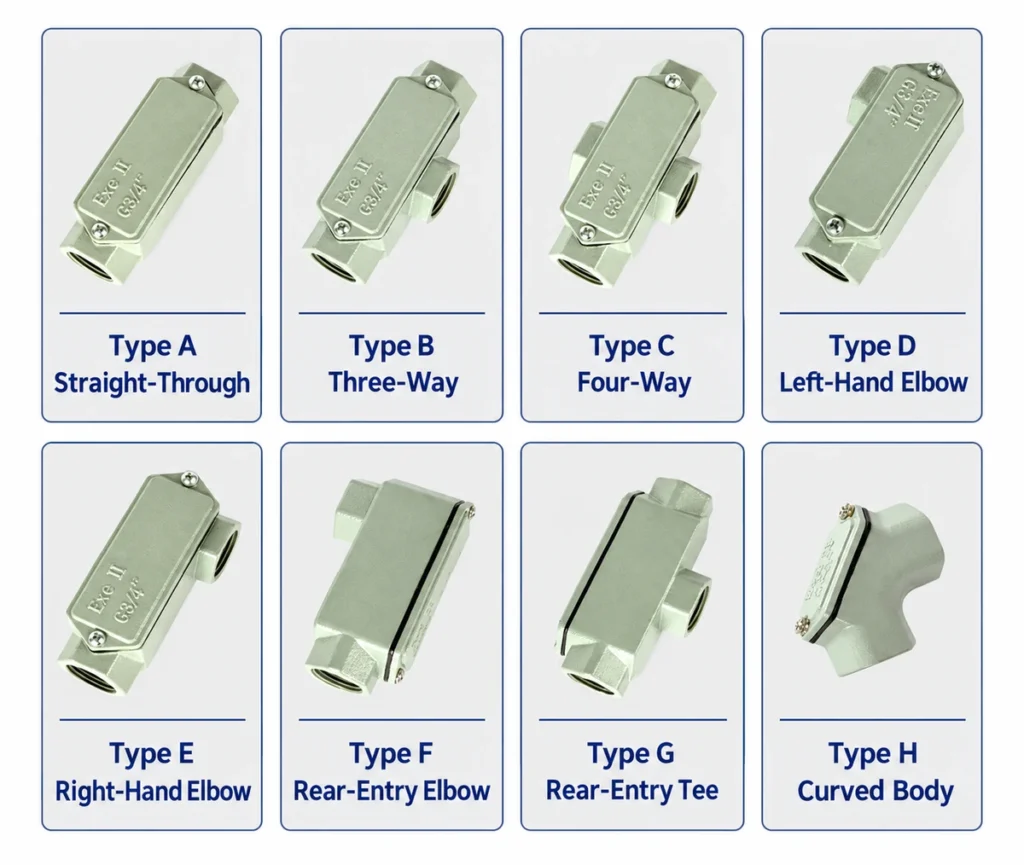
Straight-Through
Extends straight conduit runs while maintaining a continuous, enclosed conduit system.
Right-Angle
Provides a 90° change of direction for routing conduit around wall corners and equipment. Available in left-hand and right-hand configurations.
Three-Way
Allows one conduit run to branch into two, providing a simple branching arrangement.
Four-Way
Connects conduit runs in multiple directions and is designed for complex conduit layouts.
Curved-Body Designs
Features a curved internal passage to reduce sharp cable bends, protect cable insulation and minimise abrasion during cable pulling.
Choosing the Material
Cast Aluminium
Cast aluminium offers a relatively lightweight construction. The alloy and surface treatment should suit the moisture, chemicals and mechanical conditions at the installation site.
Explore our cast aluminium conduit outlet boxes for available configurations and thread options.
Stainless Steel
Stainless steel is useful where corrosion resistance is a priority, but the grade needs to match the exposure. Salt, chemical concentration and temperature can all affect its performance. Outokumpu
For coastal or chemically exposed locations, review these conditions before choosing a material. See our stainless steel conduit outlet boxes for construction and connection details.
Installation Details That Matter
Installation Details That Matter
- Use the box for its approved purpose. Add splices or terminals only where the permitted configuration allows them.
- Match the connections. Confirm the thread type, size and required engagement, and follow the manufacturer’s tightening and sealing instructions.
- Protect the conductors. Respect the required bend radius and filling limits. Check for sharp edges, damaged entries and anything that could damage the insulation during pulling.
- Plan accessible pulling points. Set their positions according to the conduit route, cable requirements and applicable installation rules. Allow room to remove the covers after installation.
- Maintain the complete assembly. Check covers, fasteners, specified seals, bonding connections and signs of corrosion. Follow the site’s isolation procedures before opening a box or carrying out maintenance.
Choosing a Box for Your Project
A useful enquiry starts with the conduit layout. Show the entry positions, thread type and size, installation space and quantity. Include the hazardous-area requirements and any material or certification requirements.
At NOVUS ELECTRICAL, we can review these details with you and discuss suitable configurations.
Send us your drawings or requirements, and we will prepare a quotation based on the agreed specification.
Looking for Explosion-Proof Conduit Outlet Boxes?
Send us your drawings or requirements for a quotation. Include the box type, thread specification, material and quantity.