
Choosing explosion-proof control stations involves more than selecting push buttons, switches and indicator lights. The Ex marking helps you check whether the equipment matches the hazardous area where it will be installed.
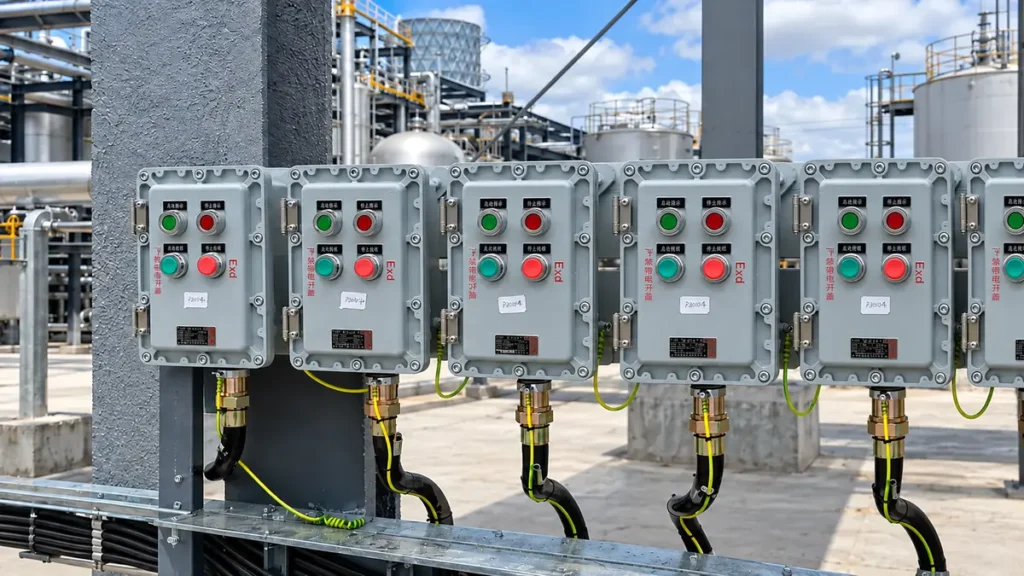
A typical marking may look like this:
Ex db IIB T6 Gb
Ex tb IIIC T80°C Db
IP66
These three lines describe gas protection, dust protection and protection against the entry of dust and water.
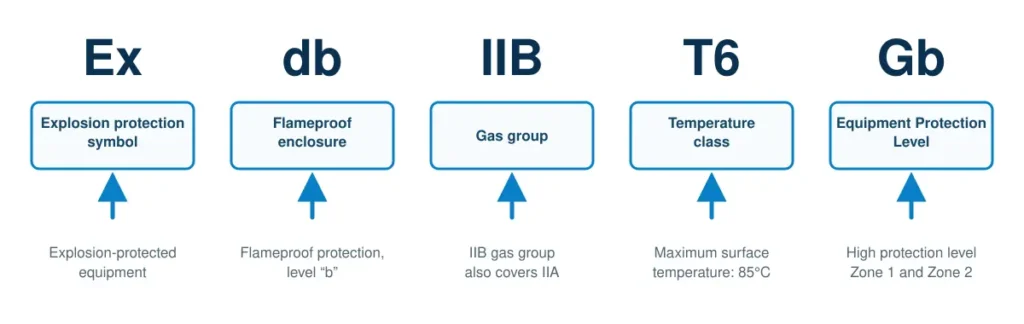
Ex db IIB T6 Gb: Gas Protection
This line applies to environments containing flammable gases or vapours.
Ex
Ex shows that the equipment is designed for use in an explosive atmosphere. It is only the beginning of the marking. The letters and numbers that follow describe the actual protection method and application range.
db
db means flameproof enclosure with protection level “b.”
Push buttons and switches may produce sparks inside a control station. A flameproof enclosure is designed to withstand an internal explosion and prevent it from igniting the gas atmosphere outside.
This does not mean that the enclosure is airtight or that sparks cannot occur inside it. The protection depends on the enclosure strength, flameproof joints and approved construction.
IIB
IIB is the gas group.
Gas groups are divided into IIA, IIB and IIC. Equipment marked IIB can normally be used for IIA and IIB gases when all other requirements are met.
Examples include:
- Propane: IIA
- Ethylene: IIB
- Hydrogen and acetylene: IIC
An IIB control station is therefore not suitable for an IIC atmosphere based on this marking alone.
T6
T6 is the temperature class. It limits the maximum surface temperature of the equipment to 85°C under its specified operating conditions.
This does not mean that the ambient temperature can reach 85°C. The permitted ambient temperature range is listed separately on the product nameplate, certificate or datasheet.
Gb
Gb is the Equipment Protection Level for gas atmospheres. It provides a high level of protection and is generally used in:
- Zone 1
- Zone 2
It is not intended for Zone 0 unless the equipment also carries an appropriate Ga marking.
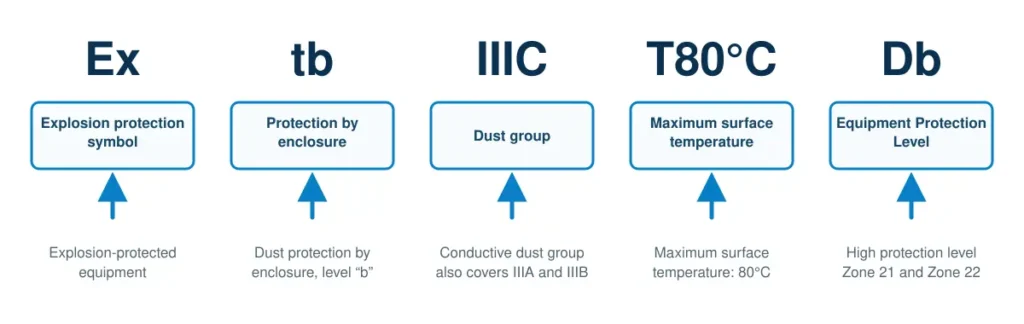
Ex tb IIIC T80°C Db: Dust Protection
This line applies to environments containing combustible dust.
tb
tb means protection by enclosure with protection level “b.”
The enclosure limits the entry of combustible dust and controls the surface temperature of the equipment. Both conditions are necessary because accumulated dust may enter electrical equipment or become hot enough to ignite.
IIIC
IIIC is the dust group for conductive combustible dust.
The dust groups are:
- IIIA: combustible flyings
- IIIB: non-conductive combustible dust
- IIIC: conductive combustible dust
From the equipment-group perspective, IIIC equipment also covers IIIA and IIIB dust. However, the ignition temperature and site conditions must still be checked before installation.
T80°C
T80°C means that the maximum surface temperature of the equipment is 80°C under the specified conditions.
The gas marking uses a temperature class such as T6, while the dust marking states the temperature directly. That is why the same control station can be marked T6 for gas and T80°C for dust.
For a dust application, compare this temperature with the ignition temperatures of both the dust cloud and any dust layer that may form on the equipment.
Db
Db is the Equipment Protection Level for dust atmospheres. It is generally suitable for:
- Zone 21
- Zone 22
Equipment for Zone 20 normally requires the higher protection level Da.
What Does IP66 Mean?
IP66 is separate from the Ex marking.
The first 6 means that the enclosure is dust-tight. The second 6 means that it is protected against powerful water jets under the specified test conditions.
IP66 does not mean that the control station can remain underwater. It also does not describe corrosion resistance. The enclosure material must be selected separately according to the installation environment.
Choosing the Enclosure Material
After confirming the Ex marking, consider the installation environment.
Cast Aluminum Explosion-Proof Control Stations are widely used in general industrial environments. They provide a useful balance of mechanical strength, weight, heat dissipation and cost.
Stainless Steel Explosion-Proof Control Stations are better suited to highly corrosive or humid environments, including chemical plants, coastal areas and offshore facilities. The required stainless steel grade should be selected according to the actual corrosive substances present.
GRP Explosion-Proof Control Stations provide a lightweight and corrosion-resistant option for many chemical, dusty and outdoor applications. Check the product’s antistatic properties, temperature range and certificate before selection.
The protection method and Ex marking may differ between materials and models. Always check the certificate for the exact product configuration.