
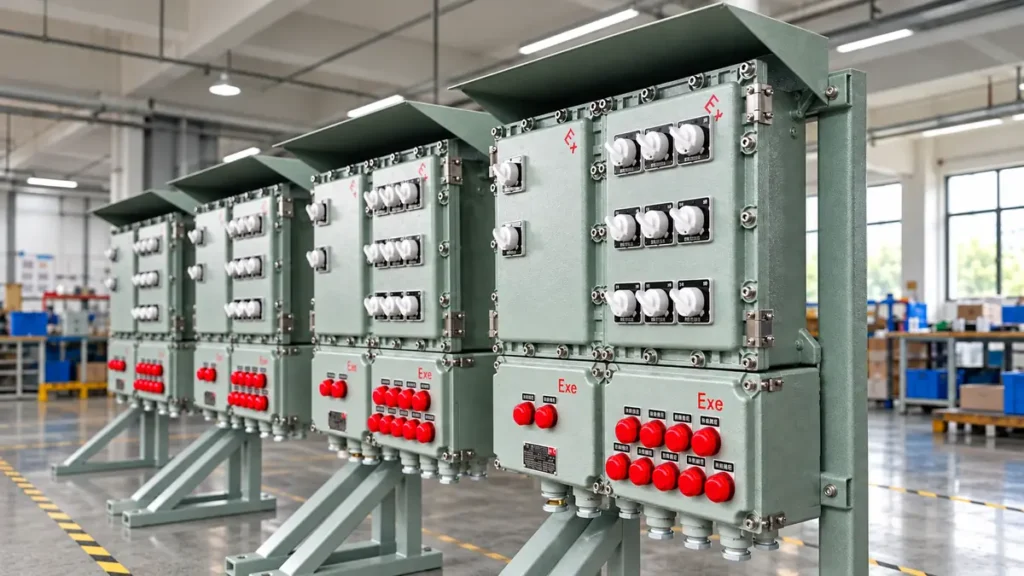
Spend any time around oil refineries, chemical plants or pharmaceutical facilities, and you’ll often see heavy-duty metal enclosures carrying an “Ex” marking on the nameplate.
When people first come across an explosion-proof distribution panel, a fairly obvious question comes to mind:
“So it’s basically a heavy-duty metal box that keeps an explosion trapped inside?”
Well, you’re halfway there.
The engineering behind explosion protection is a little cleverer than that.
Let’s leave the dry selection guides on the shelf for a moment. We’re going to look under the lid of this heavy metal box and see what makes it work—from the way it prevents an explosion from spreading to the manufacturing details that make that possible.
1. What Actually Makes It “Explosion-Proof”?
First, let’s clear up a common misunderstanding: “explosion-proof” does not mean the box is designed to survive an explosion happening outside it.
The purpose of explosion protection is to stop electrical equipment from igniting the surrounding explosive atmosphere. Different protection methods achieve this in different ways.
Here, we’re focusing on flameproof protection, known as Ex d, a common approach for industrial distribution equipment.
Its logic sounds slightly surprising at first:
An explosion may happen inside. The enclosure must withstand it and prevent it from igniting the atmosphere outside.
Two things make this possible.
A Strong Enclosure Takes the Pressure
Imagine a flammable gas-and-air mixture finding its way into the enclosure. A circuit breaker operates, produces an electrical arc, and ignites that mixture.
The pressure rises sharply.
At that moment, the enclosure has a very specific job: withstand the internal explosion without rupturing or suffering damage that compromises its protection.
Those thick walls and rows of bolts suddenly start to make sense.
Precisely Machined Joints Stop the Flame from Spreading
Now for the clever part.
The joints between the enclosure body and its cover are carefully engineered. Their length, clearance and surface finish form what is known as a flamepath.
As hot combustion gases pass through these narrow passages, heat transfers into the surrounding metal. The flamepath quenches the flame and prevents the internal ignition from spreading to the explosive atmosphere outside.
That apparently ordinary joint around the cover is doing some serious work.
The construction and testing requirements behind this protection method are set out in IEC 60079-1, the international standard for flameproof enclosures.
2. How It’s Made: Where the Real Work Happens
Once you understand the principle, the manufacturing process becomes much more interesting.
Building a flameproof distribution box takes considerably more than bending some sheet metal and fitting a door. Depending on the design and material, it involves casting or welding, precision machining, surface treatment and careful assembly.
Let’s follow it through the workshop.
Enclosure Forming: From Molten Metal to a Solid Body
Cast aluminum alloys are widely used because they offer a useful combination of manageable weight, heat dissipation and suitability for casting.
High-pressure die casting
Picture molten aluminum alloy being forced into a steel mold under high pressure. Once it cools, out comes the basic enclosure shape, ready for further processing.
The process can produce a smooth surface and consistent dimensions. But a good-looking casting is only the beginning.
Wall thickness, porosity and other casting defects all matter. The finished enclosure still has to meet the pressure-resistance requirements of its design.
Welded stainless steel
For corrosive environments, including offshore installations, stainless steel explosion-proof enclosures may be fabricated from 304 or 316L stainless steel, with the grade chosen to suit the service conditions.
TIG welding is one manufacturing option.
The tricky part is controlling distortion. Welding introduces heat, and heat can pull metal out of shape. The finished enclosure and its machined joints must still meet the specified dimensions.
A small amount of movement in the wrong place can become a very big problem.
Flamepath Machining: The Operation That Really Matters
If the enclosure is the skeleton, the flamepath is its soul.
In the machine shop, the mating surfaces of the body and cover are precisely machined to achieve the required geometry and finish.
You may see a surface roughness requirement such as Ra 6.3 μm or finer, depending on the applicable requirements and design.
But smoothness is only part of the story.
Dimensions leave little room for guesswork
Flamepath length and maximum clearance depend on factors such as joint type, enclosure volume, gas group and the certified design.
There is no single gap or flange width that can be applied to every flameproof box.
We’re often talking about fractions of a millimeter here. “Looks close enough” has no place on the inspection sheet.
Corrosion protection matters, too
Once those surfaces have been machined, they need protection from damage and corrosion.
Rust and pitting can compromise a carefully finished joint. Suitable corrosion protection, such as a manufacturer-specified non-hardening grease, helps preserve it.
The treatment must remain compatible with the flamepath requirements. An ordinary coat of paint over the mating surfaces is no quick fix.
Surface Treatment: More Than a Fresh Coat of Paint
An enclosure may spend years facing moisture, salt spray or chemical exposure. Its surface finish has a practical job to do.
The process often starts with blasting and ends with a protective coating.
Blast cleaning
Suitable blasting media remove surface oxides and residues and create a consistent surface profile for coating adhesion.
Think of it as preparing the canvas. If the surface preparation is poor, even an attractive finish can struggle to stay attached.
Electrostatic powder coating
Electrically charged powder is applied to the prepared enclosure and then cured to form a protective layer.
Epoxy-based systems are one option. Some specifications call for coating thicknesses around 80–120 μm, although the coating type and thickness depend on the product and its intended environment.
The aim is a durable barrier against the conditions the enclosure will actually face.
Precision flamepaths must be protected during finishing so the coating does not interfere with their function.
Internal Assembly: The Details Behind the Cover
The inside deserves just as much attention as the outside.
Separate compartments, different jobs
Some distribution boxes combine a flameproof switching compartment with an increased-safety terminal compartment, known as Ex e.
The circuit breakers or other switching components sit in the flameproof section, while field wiring connects in the terminal section.
This arrangement can make installation and maintenance more convenient because technicians can access the terminals without disturbing the main flameproof compartment.
The terminal compartment still forms part of equipment used in a hazardous area. Access and maintenance require the appropriate electrical isolation and the manufacturer’s specified procedures.
Cable and conduit entries
Every cable entry must match the enclosure’s protection method and installation requirements.
Where compression seals are used, they must suit the cable diameter and be correctly fitted. Some applications require barrier glands or other sealing arrangements.
For conduit connections, thread form, engagement and sealing must follow the applicable requirements and certified design.
A few threads catching is no assurance that the connection is suitable.
3. The Small Details Behind a Bigger Price Tag
Put two distribution boxes side by side, and they may look much the same.
So why does one cost considerably more?
Some of the answer may be hiding in parts that barely get a second glance.
Fasteners That Do More Than Hold the Lid On
Stainless steel fasteners can help resist corrosion, and captive screws make servicing easier by staying attached when the cover is opened.
Anyone who has dropped a screw through an open platform grating will appreciate that last detail.
For a flameproof enclosure, though, the fastener’s strength, size and engagement are critical. The correct grade and specification must match the certified design.
A shiny stainless steel bolt is useful only if it is also the right bolt for the job.
Cable Glands and Their Seals
Take explosion-proof cable glands. They may look like small accessories, but they perform an important job at the enclosure boundary.
The sealing material must suit the temperature and chemical exposure. Nitrile rubber, or NBR, is one option where its properties match the application.
The seal also needs to fit the cable within the gland’s specified diameter range.
An IP66 rating—or a higher rating where specified—depends on the complete entry arrangement and correct installation. The rubber ring cannot do the whole job by itself.
External Operating Mechanisms
Being able to operate a switch without opening the enclosure is a useful feature.
An external handle drives the internal switch through a shaft or linkage. Where that shaft passes through a flameproof enclosure wall, the penetration also needs an appropriate flameproof construction.
That simple turn of a handle relies on careful mechanical design, alignment and machining.
It is a small movement backed by quite a lot of engineering.
One Last Look at That Heavy Metal Box
A flameproof distribution box brings together several carefully controlled parts: the enclosure, its joints, its fasteners, its cable entries and the equipment inside.
Think of the journey through the factory.
Molten metal fills a mold. A cutting tool passes across a flange. An inspector checks a clearance measured in fractions of a millimeter. During assembly, someone checks that a seal is the correct size and properly seated.
Each step contributes to the same goal: preventing an ignition inside the equipment from becoming an explosion outside it.
So the next time you walk past a thick, bolt-covered box in a chemical plant, take another look.
Those heavy walls, closely spaced bolts and carefully machined joints all have a job to do.
Under that unassuming metal exterior is a very serious respect for what one small spark can start.
Looking for Explosion-Proof Distribution Panels?
Send us your required Ex marking, electrical ratings and circuit configuration for a quotation.